|
Nature conservation
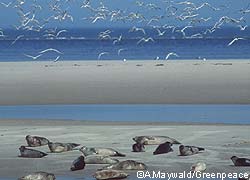 Valuable coastal regions Valuable coastal regions
Germany's coastal regions on the North Sea and the Baltic are very valuable ecological systems. These strips of coast provide an important habitat for many species. The coastal states have designated large areas as nature reserves, a reflection of their high value. The Wadden Sea is one of the world's most important resting places and feeding areas for migratory birds. Its entire area, with the exception of the river estuaries, has been designated a national park. For this reason, Denmark, Netherlands and Germany, the countries with coasts on the Wadden Sea, have agreed not to licence any wind turbines within it.
Wind energy and birds
 The possible negative effect of wind turbines on birds was an issue for a long time and has cropped up again in recent years in connection with offshore wind. Some feared or prophesised that turbines would have a significant or even massively destructive effect on birds, but this was clearly proven wrong on land. The possible negative effect of wind turbines on birds was an issue for a long time and has cropped up again in recent years in connection with offshore wind. Some feared or prophesised that turbines would have a significant or even massively destructive effect on birds, but this was clearly proven wrong on land.
Some bird species do change their behaviour, indicating that turbines have a certain "scarecrow effect". After a wind farm is built, some species keep their distance during the brooding season or when they are searching for food. After a time, however, they get used to the turbine, as other wild animals are seen to do, so that behavioural changes nearly always disappear.
 Migratory birds fly around or over turbines, so that no significant damage happens to them. At present there are no comprehensive research findings on the influence of offshore wind turbines on birds. However, initial reports from offshore projects in other countries indicate that the situation is similar to what happens on land. Birds looking for a place to rest for the moment keep distance temporarily; migratory birds fly around the facilities. Migratory birds fly around or over turbines, so that no significant damage happens to them. At present there are no comprehensive research findings on the influence of offshore wind turbines on birds. However, initial reports from offshore projects in other countries indicate that the situation is similar to what happens on land. Birds looking for a place to rest for the moment keep distance temporarily; migratory birds fly around the facilities.
Gaps in knowledge
There is still not enough information available to assess the possible effects of offshore wind turbines on the marine environment. As far as it can, a detailed assessment programme carried out by the federal environment ministry is supposed to fill in existing gaps in research on this question. The programme will direct most of its attention to the possible effect of offshore turbines on migratory birds but also to their possible effect on marine mammals such as seals and the common porpoise. The research programme's findings will be available at the end of 2003. Wind farm planners have also commissioned experts to prepare comprehensive reports on nature conservation; these will also play an important role in answering these questions.
Ultimately, only when operators have gained experience with the first larger pilot projects the effect of offshore wind farms on nature and the marine environment can be reliably assessed. Of course, assessment should incorporate available results from research projects abroad.
Possible nature reserves in the exclusive economic zone
 Until now it has not been legally possible to formally declare nature reserves within the German exclusive economic zone (EEZ). But this will change when the amendment to the Federal Nature Conservation Act (BNatSchG), passed by the Bundestag, the German parliament, takes effect. Regions in the EEZ that are closer to shore will be assessed first, to identify areas worthy of protection and such areas can be given formal status as nature reserves. Subsequently, areas suitable for wind farming can now also be formally allocated. A change in the Marine Facilities Ordinance, a result of amending the BNatSchG, will enable authorities to formally identify such areas. Until now it has not been legally possible to formally declare nature reserves within the German exclusive economic zone (EEZ). But this will change when the amendment to the Federal Nature Conservation Act (BNatSchG), passed by the Bundestag, the German parliament, takes effect. Regions in the EEZ that are closer to shore will be assessed first, to identify areas worthy of protection and such areas can be given formal status as nature reserves. Subsequently, areas suitable for wind farming can now also be formally allocated. A change in the Marine Facilities Ordinance, a result of amending the BNatSchG, will enable authorities to formally identify such areas.
Assessing and possibly allocating nature reserves and areas suitable for wind farms will offer much more legal security to applicants submitting plans for projects within the EEZ. Applicants have already submitted plans for projects partially within such proposed nature reserves as the Important Bird Area ( IBA) off the coast of Schleswig-Holstein. This poses certain risks from the legal point of view. In the past, the European Court of Justice turned down some building projects (not wind energy) in areas that were proposed nature reserves but had not been assessed or awarded formal status as such. Not until such areas are actually assessed and, if necessary, given formal status as nature reserves, can the licensing of construction projects in them be considered legally binding. IBA) off the coast of Schleswig-Holstein. This poses certain risks from the legal point of view. In the past, the European Court of Justice turned down some building projects (not wind energy) in areas that were proposed nature reserves but had not been assessed or awarded formal status as such. Not until such areas are actually assessed and, if necessary, given formal status as nature reserves, can the licensing of construction projects in them be considered legally binding.

|


 Aktionskonferenz Nordsee: (Seas at Risk) on offshore wind
